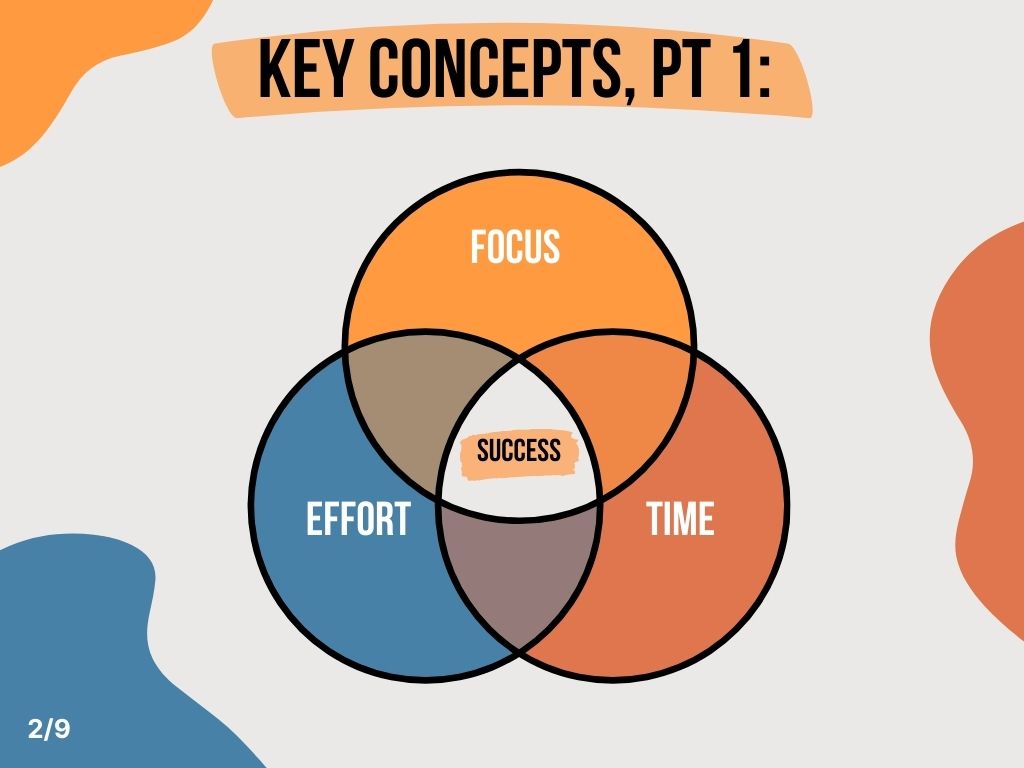
While onboarding a new client recently, we put the finishing touches on his success framework, which helps define what actions need to be taken in order for him to meet his goal.
It’s the bridge that helps him get from where he is to where he wants to be.
I wanted to share the general framework here so that others can use it.
You can check out the full slide deck on my social media (above) for the highlights, but I wanted to dive a bit deeper here.
The framework is broken down into three distinct parts:
Number 1 is an awareness of the key concepts and their definitions:
- Focus: where you want to go? Why?
- Effort: how hard do you need to work?
- Time: how long will it take?
Number 2 is what happens when two of the circles overlap, but leave out the third. These intersections have their own name and characteristics:
- Low Harvest = Focus + Energy, but no time. This happens when you have someone with extreme clarity on their goals working really hard…for a short amount of time.
- Folks at this intersection often find themselves with feelings of worry, distress, and compare their outcomes to others.
- No Harvest = Focus + Time, but no effort. These are the dreamers. They have a crystal clear vision of what they want and are patient for it to arrive. Yet they never do any actual work.
- People at this intersection are typically caught in the tension of “I’ll get started tomorrow”, leaving them filled with frustration in themselves as they grapple with a failure to do anything.
- Wrong Harvest = Time + Effort, but no focus. These are the ones who plant pumpkin seeds, till the soil, and water perfectly. Then they’re shocked when an apple tree grows. They spent a lot of time working really hard only to be confused by their outcome. This leaves them exhausted with nothing to show for all their efforts.
Number 3 is where the rubber meets the road and helps you figure out how to avoid the intersections described above. In short – it’s solution time.
- Want to get really clear on your focus? Then answer these questions, honestly:
- What harvest do you want to reap? Want to grow apple trees – then say that! Want to go on monthly date nights with your wife – then say that! Define it with as much detail as possible. In the fitness world, the worst thing someone can say is ‘I want to lose weight.’
- What distractions and obstacles have I encountered previously? This brings in your past experience as well as forcing you into thinking through how things might rob your focus. Do you frequently grab your phone to make a necessary social media post for your business and then find yourself in a puddle of drool two hours later after doom scrolling? Then list that.
- Where am I starting from? This keeps you honest about the gap between where you are and where you want to go. It also helps inform and influence the steps within the plan you (or your coach) design.
- Does this align with my values? I wrote in depth about this here, but the cliffs notes are this: we start with values because they offer a strong anchor that you can tie actions around to eventually create habits that turn into sustainable behaviors. Values deepen the buy-in to the work that needs doing, especially when things get tough or mundane.
- Want to get really clear on the effort required to reach your goal? Then answer these questions:
- What specific actions do I need to take? In the gym, this could be exercise selections, set, reps, rest, load, etc. At home, this could be your Saturday routine beginning at 8am: mow the lawn, clean the pool, wash the cars. You get the picture – the more detail, the better.
- What resources do I have available to sow? This can be time, money, your network, etc.
- Do I know anyone who has achieved this that I can ask about the work required?
- Is this adding to, or replacing, my current workload? Plainly put, this helps you understand if you will be working more hours or the same hours, but just differently.
- Want to get really clear on the time required to reach your goal? Then answer these questions:
- How soon do I need (or want) to reap what has been sown?
- Is this timeframe reasonable based on past experiences? How about after talking with others that have achieved similarly?
- What markers of progress would I like to see? This is helpful to have in place ahead of time, so that when you don’t see the metaphorical scale moving, you can have a different measuring stick that you are making acceptable headway.
- Does this align with my priorities? As outlined in the blog I linked about, priorities are a measurement of where we spend our time.
Next time you’re working towards something and find yourself caught with either the wrong harvest, low harvest, or no harvest, focus on the one key concept that is missing and answer the questions related to it.
Feel free to do so with yourself, your family, your work, or clients of your own. Let me know if you find it helpful…and please share it!
 For Glory
Leave a comment