-
Teach Your Kids How to Drive a Manual Transmission

When I’m coaching, teaching, and working with others, I often find that a lot of my methods and analogies come from the automotive world. This is as much by chance as it is design.
I had a friend ask me once if I had any advice for raising good, hardworking kids. Of course I mentioned all the resources we’re given through Scripture. But to conclude with my own spin, I simply said: “teach your kids how to drive a manual transmission.”
Now, did I mean this literally? Well, yes, as a matter of fact I did. But I also meant it figuratively.
I meant it literally for the following reasons:
It’s a dying art.
It takes time to learn.
You can always get better.
It’s a modern day theft deterrent.
Gives you greater control over your car.
Connects you more directly to the source of power.
It severely limits one’s ability to use their phone while driving, a net positive for all.
Prepares you for the inevitable public embarrassments you will encounter throughout life. Only people who’ve stalled out in a busy intersection will get this one!
But figuratively speaking, here’s why I think you should do it:
It forces you to learn and teach a skill that you probably don’t have.
It is something that requires a combination of physical and cognitive effort.
You have to spend time together in the real world.
You can’t be passive, it requires your continual presence.
It’s simple and timeless, but not easy.
But it’s not hard for the sake of “doing hard things.”
You will spend a lifetime trying to get better – this is the pursuit of mastery – getting better and better at something that matters.
Feedback is visceral and nearly immediate.
There is joy in getting it right, and you’ll experience frustration when you don’t.
You experience gratitude for those who taught you.
The wonder you’ll feel as you help someone to an ‘aha’ moment is worth it’s weight in gold.
Boiling it down, it forces you to ask the questions:
- What do I want to teach my kids that will take time, effort, and focus that will lead to a life well lived?
- What does that require of me? The more patience, effort, time, and dedication, the better.
It doesn’t have to be a teaching them to drive manual transmission.
But it’s a darn good place to start.
-
Why Dads Are Essential in Homeschooling: Lessons from My Journey Walking this Road

I recently wrote about our family’s journey with homeschool thus far, where I ended by calling on other dads to get involved in the homeschool journey.
But I didn’t really recognize the importance of that call to action until after a conversation I had with our community director, Noelle. We were talking about the challenges that families commonly face when it comes to making the decision to homeschool. And I know there are a lot. But the one that I could relate most to was the role that fathers play.
Not surprisingly, the saying “as the father goes, so goes the family” is alive and well.
Put another way – if dad is on board, we see a family decide to homeschool. If dad is not on board, there is almost zero chance of it happening. And if it does happen, it often doesn’t last.
Dads – we are essential in not only influencing the decision to homeschool but also in shaping the success of the journey itself. Our leadership, presence, and support can transform this education choice into a thriving experience for the entire family.
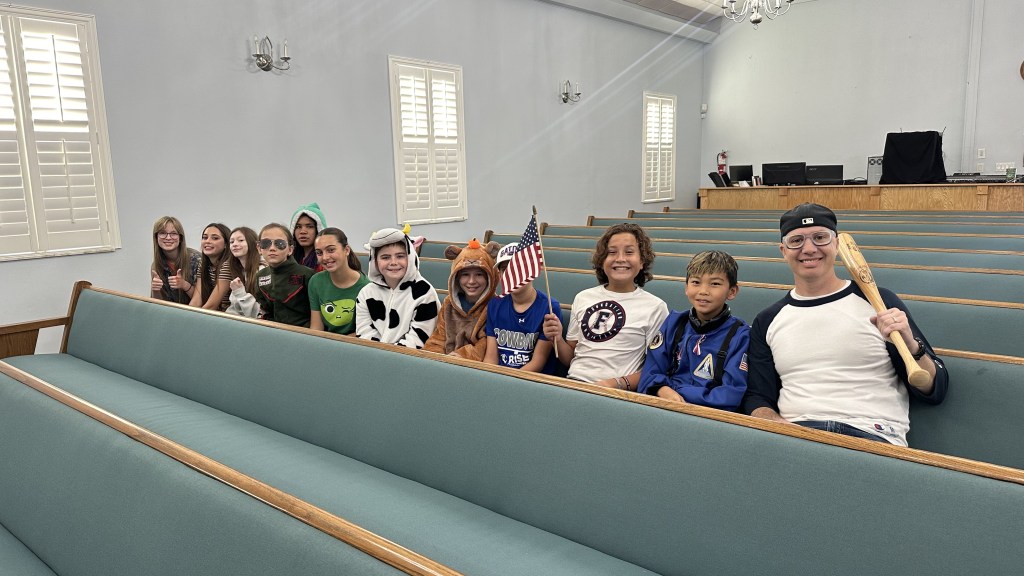
Why Dads Matter in Homeschooling
First and foremost, we set the tone for our families.
When we value education, our children see it.
When we prioritize faith, our children see it.
And when we show up – not just as providers but as active participants in their education – we teach them that their growth matters deeply to us.
Here’s another crucial part – our spouses need this too.
This is one of the first lessons I learned on this journey – homeschooling is hard. Anyone who tells you differently is wrong. But it’s so worth it! What else would you rather your family invest in if not your children and the next generation? Mandy and I have grown closer and closer as we’ve navigated this together. We’ve had to lean on each other’s strengths and communicate more intentionally. For example, her creativity and diligence in planning have inspired me to step up my game. I know my Challenge A class appreciates this!
Another lesson? Dads bring a unique perspective to the homeschool community. We can show up as tutors and teachers, yes, but also as spiritual leaders, encouragers, and role models. Since there aren’t many male figures around, the impact we make is even greater.
And here’s a final lesson I learned – the biggest adjustment isn’t on the kids. It’s on us, the parents. The amount of “unschooling” we need to do in our own heads is mind-boggling. But as Kevin McAllister said in Home Alone, “it’s for the kids.”
Yes, homeschoolers might have seemed unconventional to me growing up. Now, we’re (proudly) among the feral ones running around with no socks and shoes. But I’ve come to embrace the incredible growth and learning happening daily, and I wouldn’t trade it for anything. Because this isn’t about convention, it’s about transformation.
How Dads Can Get Involved in Homeschooling
So what are some ways you can get involved and contribute?
- Be the Encourager: Celebrate victories and support your family through challenges. A kind word can change the course of the day.
- Lead Devotions: Start the day with prayer or a Bible study. This sets a spiritual foundation for the day.
- Teach a Subject: Share your expertise. For me, that’s often been math, writing, or physical education, but it could be anything you love.
- Plan Adventures: Field trips, hikes, or even backyard experiments can bring learning to life.
Dads, your role in homeschooling is more critical than you might realize. Your family looks to you for leadership and assurance. When you step into this role with courage and intention, you’re not just shaping your child’s education—you’re leaving a legacy of faith, strength, and love.
A Final, Most Important, Note
Our family doesn’t get this right all of the time. As with most snapshots in time, the way things look for us today is the result of trial and (lots of) error.
And none, absolutely none, of this would happen without the daily work Mandy puts in.
Although I am fairly involved as a homeschool tutor with our community group this year, my days at home are vastly different than Mandy’s. The part that I play today, at home, is quite similar to when we first began this journey and it’s what I recommend to other dads who want to help:
- As mentioned above, be an encourager. The days are long and the frustrations are many. Point out the progress you see, because while the long view is one of blessing and flourishing, when you’re in the dirt it’s hard to see the clouds.
- Listen. Don’t offer ‘a fix’ all the time. Just give space, ask questions out of genuine curiosity. For instance, lots of listening will be done around what curriculums are being considered!
- Offer reassurance. Like I said above, many times it can feel as if you are ruining your kids education despite knowing that isn’t true. Encouragement keeps you going, reassurance keeps you focused on the vision.
Let’s walk this path together. Share your thoughts or experiences in the comments—I’d love to hear how you’re navigating this journey. And if you’d like some guidance, reach out.

-
The Martin Homeschool Journey

This year, we enter our 5th year of homeschool.
I’ve had a lot of people begin to ask me more and more questions about how it works, what we do, how involved I am, etc. so I thought I’d write this to help anyone who has similar questions.
We are part of a community called Classical Conversations, known as ‘CC’ for short.
CC is a classical education curriculum through a Christian worldview.
I won’t go into immense detail on the inner workings of CC, but there are a few highlights worth mentioning:
As a community, we get together in person every Tuesday, similar to a typical public school day. (But as Mandy and I like to jokingly say, we’re all a bit more feral than public school. Lots of bare feet, running around, and big laughs.)
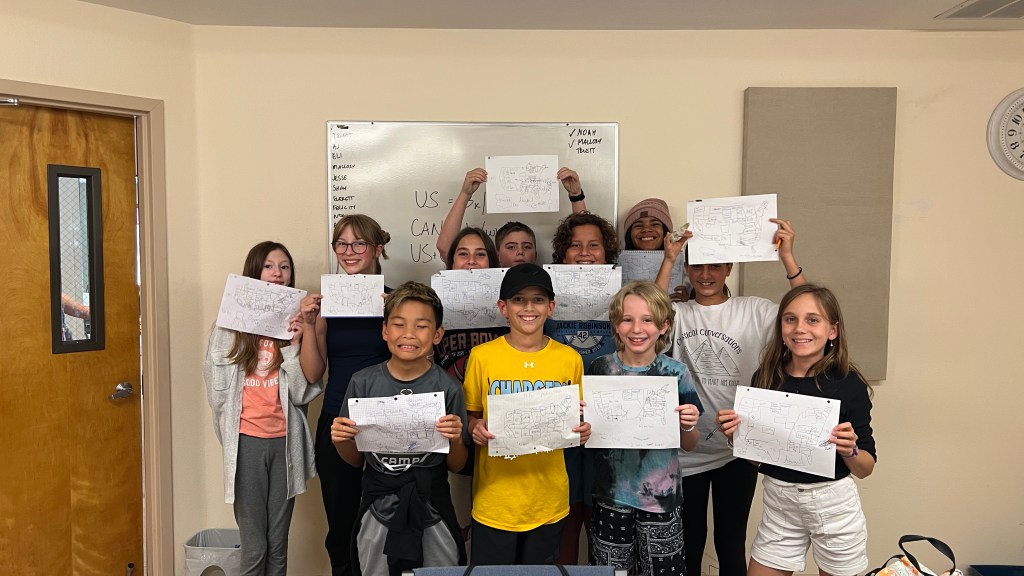
Like any other community, we have our own language of sorts. “Normal” subject names won’t suffice. To start off, they’re called ‘Strands’ not subjects. Some of these go by different names while others have been removed from traditional school altogether. Here is a snippet of what these kids are learning:
- Grammar
- History
- Timeline of the world (quite possibly the coolest thing they do.)
- Latin
- Geography
- Fine Arts (including music theory, famous orchestra composers, and artists)
- Tin Whistle (every parents worst nightmare…kidding!)
- Logic (Math)
- Debate (Cartography, mock trial, and more)
- Exposition (Writing, literature, along with diagramming and parsing sentences)
- Reasoning (Analogies and Clear Reasoning)
- Research (Hands on science experiments)
- On top of all that, they practice public speaking, every week. Yes, even at the youngest ages. (What I wouldn’t give to go back in time and have had that for myself. Lots of sweat and anxiety in a college classroom could have been avoided!)
I remember my first day of CC with our kids like it was yesterday. While many people might be turned off by what appears to be chaos, I felt right at home. We’ll get back to that part of this story in a few.
We don’t have traditional grade levels. The program is broken into three main parts, and I’ve included the grade level equivalents in parentheses: Foundations (K-6), Essentials (4th-6th), and Challenge (7th-12th). The former two are 24 week programs while Challenge is 30 weeks.
Class sizes at all levels range from 2-12. In our community, we have 5 Foundations classes, 2 Essentials classes, and one class at each Challenge level. For the latter, it goes Challenge A, B, 1, 2, 3, 4.
So for our two kiddos it works out like this:
Quinn is 9 and is in the Foundations and Essentials programs.
Jesse is 12 and is in the Challenge A program.
Our Tuesday CC day runs like this:
Foundations kiddos meet in their classes, with their tutor, from 9:00am-12pm.
Essentials kids meet in their classes, with their tutor, from 1pm-3pm.
Challenge kids meet in their classes, with their tutor, from 8:30am-3:30pm.
And now we get to the part that a lot of folks miss when it comes to homeschool.
Take note that during our community day, I didn’t refer to the ‘teacher’ that is in front of the class, but rather the ‘tutor.’ They are there to introduce or review the material for the week. These are parents of kids in the program that choose to invest in the lives of these children.
The teacher is you; mom and dad. It is each child’s parents.
Parents are known as ‘lead learners,’ which means that they are right along side their children learning the material that they teach them.
That’s why, for the rest of the week, school takes place at home. Or in the car. Or on vacation. Or wherever we happen to be when work needs to get done. Opportunities for education abound when the constraints of traditional school learning are removed.
Back to the brief story I started earlier, about my first impressions of CC. Like I said, I felt right at home. Everything that I saw happening just really lined up with our family values and I always wanted to play a bigger role in the community, similar to Mandy. She just began her 4th year as a tutor, working with Quinn’s Foundations class.
I’ve admired the joy that it brings her. Yes, she puts in a TON of work, but I also know how fulfilled she is. Being an active part of these kids, and their families, lives just absolutely fills her cup.
Fast forward to the end of 2023, when our community director Noelle Oakman casually asked Mandy if she thought I’d be interested in being a tutor. I think Mandy already knew what I’d say, but she asked anyways. She couldn’t get to the end of the question before I emphatically said YES.
Now I’m not going to lie, there was a giant part of me that felt a lot of pressure, as I’d raised my hand to be the Challenge A director – Jesse’s class. We did a lot of praying and had a lot of conversations about it, particularly with Jesse. I wanted to be sure he was okay with me being his tutor. Surprisingly, he was “pumped to have dad lead his class!”
So yes, now I’m not only learning a lot of new things (like latin!), but I’m also dusting off the cobwebs from deep in the recesses of my brain to teach writing, math, science, cartography, and reasoning. Each week requires hours of prep, but thankfully I’ve got a beautiful model in my wife to mimic.
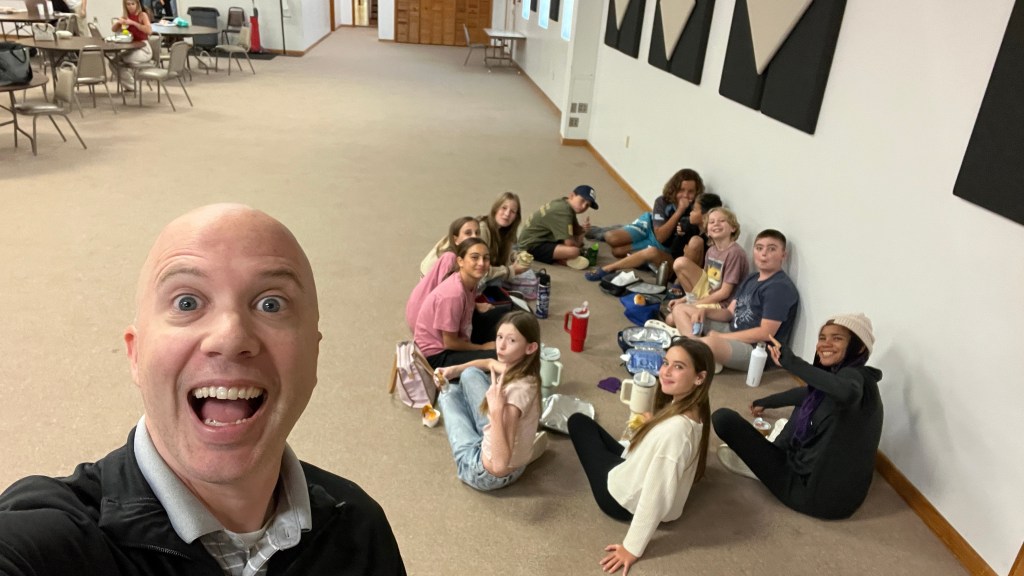
Fast forward to this week, and Jesse and I just finished our 4th week of CC. I am blessed to have eleven wonderful kids in my class. There is much negative said about this next generation, but let me tell you – these kids and their families give me nothing but encouragement for our future. They know how to think, they love and support one another, and most importantly, they love the Lord.
I’d love nothing greater than for more dads to get involved in the homeschool journey, so if you’re giving it some thought and would like more information, hit me up!

-
Leadership Lesson of the Day #2
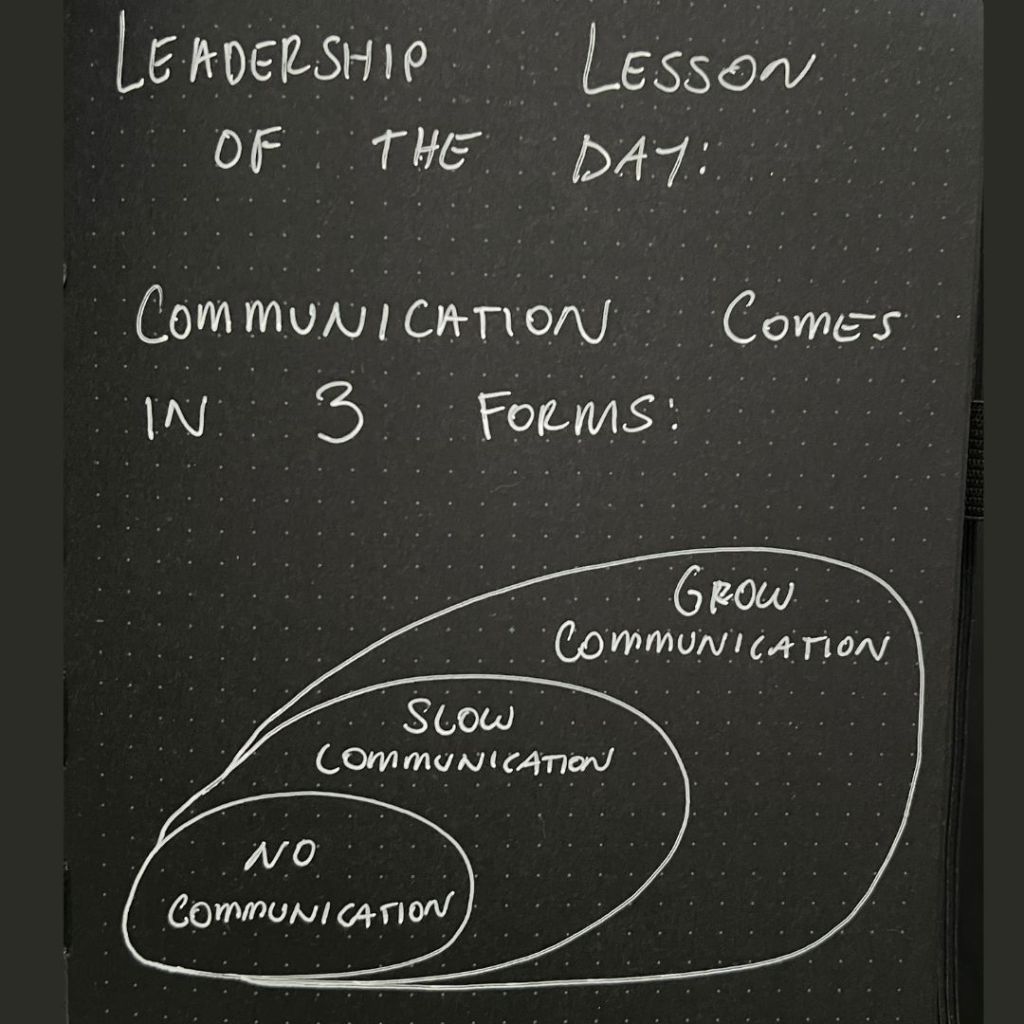
There are three distinct types of communication you can have in your business:
No communication – things remain in your head, leaving you as the only one who can truly get work done in the business. The trouble with this is that it leaves nobody to work on the business.
Slow Communication – this is where you strive for something akin to perfection as opposed to action followed by evaluation and refinement. Perfect is the enemy of done, and largely means your business goes nowhere, fast.
Grow Communication – this is where you learn how to empower your people through solid onboarding, a living playbook, clear expectations, and ongoing coaching.
Be careful not to fall into the trap of mistaking abdication for delegation. The latter involves the steps I outlined in the final stage above. The former is a recipe for failure and frustration for staff and leadership.
-
The LDDR Framework

What is the LDDR (pronounced ‘Leader’) Framework?
In short, it’s the 4-step process by which we take a business from where they are to where they want to go.
- Step 1 -> Learn: You want to achieve an outcome, so we measure where you are now. We get answers for the ‘how’ and the 5 W’s:
- Who = PEOPLE
- What = PERFORMANCE
- When = PLAN
- Where = PROGRESS
- Why = PURPOSE
- How = PROCESS
- Step 2 -> Design: We create a plan that meets you where you are, focusing on where you want to go, using the resources you have.
- Desired Outcome = CLARITY
- Obstacles = TIMELINE
- Step 3 -> Deliver: You execute the necessary action and achieve success.
- Skill Acquisition
- Skill Application
- Step 4 -> Refine: You make small refinements over time for sustained benefit.
- Evaluation
- Step 1 -> Learn: You want to achieve an outcome, so we measure where you are now. We get answers for the ‘how’ and the 5 W’s:
-
Leadership Lesson of the Day #1
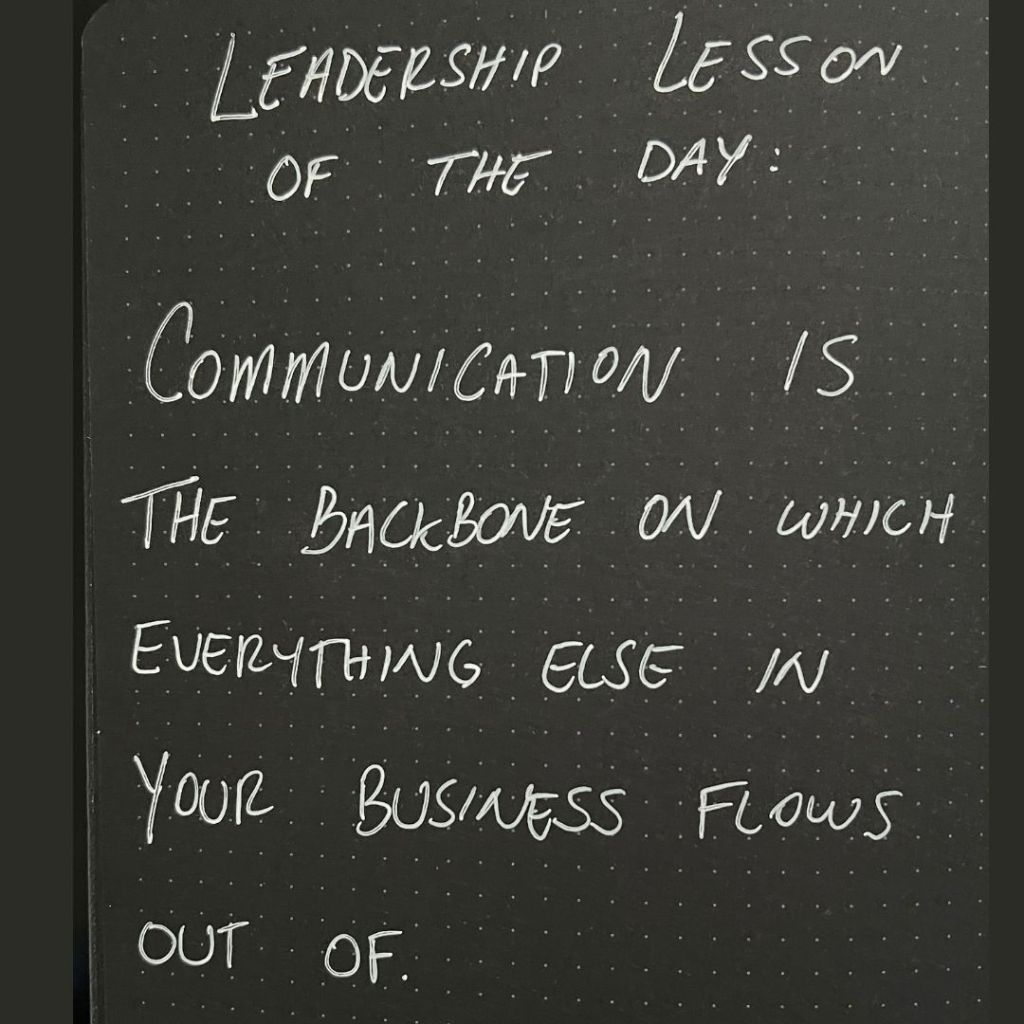
Communication is the backbone on which everything else in your business flows out of.
Much of what I’ve learned about leadership has come from two areas:
- My own failures
- Leaders I have spent time learning from, either directly or indirectly
The first has been my largest area of influence by a long shot.
You see, a big part of a leader’s role in any organization is to cast vision wrapped in a compelling purpose.
In other words, let people where they’re headed and why.
Those are two messages you are tasked with sharing, a lot.
The better you can communicate it, the more influence you’ll have.
Communication is part of successful relationships, a vehicle for transformation.
And like I said earlier, it’s something I’ve not done great at.
So these leadership lessons are for you, the reader, as much as they are reminders for me.
I hope you enjoy them.
And should something strike a cord that you’d like help with, shoot me a message, and we can communicate more privately.
-
My Dad Struck Out Pete Rose in the 1980 World Series

On three straight fastballs.
If that’s crazy to read, think about how crazy it is for me to write.
What’s stranger is that I didn’t even know that until sometime in my teenage years, around high school.
Even now, more than thirty years after finding out, I know the broad brush strokes…the highlights, but not many details.
That’s because my dad has spent a lifetime of pouring into me in other ways.

I can remember, in vivid detail, so many moments that have had lasting influence in how I lead my own family. Here are couple examples:
There’s the time that I told him I wanted to quit baseball mid-season. He calmly said I wouldn’t be quitting – that I made a commitment to stick by my teammates when I signed up and that we live up to our word in the Martin family. Of course that ended up being the best baseball season of my life.
Or the time that he told me, in no uncertain terms, that he and my mom’s relationship was the priority over us kids. As a husband and parent now, I can’t tell you how much it meant to see him exemplify the proper order of relational importance in a household.
But more than the big moments, it’s undoubtedly the daily minutiae that have had the greatest impact on me.
Things like:
His uncanny ability to make someone laugh, every day of his life. Drive-thrus, check-out lines, restaurant servers. Nobody is off limits from my dad trying to brighten your day by making you burst into hysterics.
Or how I have never known my mom to be without a fresh cup of coffee, a clean car, or a full tank of gas every day of her life.
Or the simple fact that he was home with us every night, without fail.
And without a doubt the most significant is that he never let me get out of going to church with my attempts to fake sleep. He might have had to call into my room a time or two, but he made it known that my rear end better be in the car by the time we were supposed to leave.
He’s set an incredible example of how to be a great husband, a great dad, and a great man. There are plenty of times I don’t get it right, but I’m still striving to reach the ideal he continues to model for me to this day.
This is also the reason that I’m so driven to help other dads be the best they can be for their families – I know the positive impact it can have.
If we’re all praying and working for a generational transformation, then we need to be a transformational generation.
So yea, my dad struck out Pete Rose in the 1980 World Series. But he did, and continues to do, so much more than that.
Thank you Pops!

This is the exact moment, while meeting Pete Rose, that I said ‘My dad said to tell you hi – he struck you out in the 1980 World Series.’ He never looked up prior to that statement. After that we had a great chat and shared some laughs! -
100 Days

As of today, September 22nd, there are exactly 100 days until this year is over.
What can you do with 100 days?
There’s nothing particularly special about 100 days, but then again there is something about a nice round number like that.
This time of year is usually when business owners put together their annual plans for the upcoming year to ensure they stay focused on where they want to go and what they want to accomplish.
But in nearly 100% of consultations I’ve done with new clients that I coach, nobody does this with their own family.
At best, it’s loosely discussed with their spouse in between shuttling kids all over.
At worst, things are left up to chance and it’s never realized until about 9-1/2 months into the next year that you’re in exactly the same spot as the year prior.
So here’s how I help people create the framework of an annual family plan. I call it the Triple R’s. Grab a piece of paper and a pen and follow along:
[Spoiler alert: if you’ve ever seen/heard of the rocks, pebbles, sand, and water story – this is that with specifics focused on the family unit.]
Step 1: SEASONAL RHYTHMS – Write out when your kids start and end each semester of school.
As a parent myself, and a coach who works with parents, I can’t tell you how much impact the start and end of school seasons has on how a family operates. There is no use fighting this, nor should you be surprised how family rhythms change. Rather, you should embrace it and plan accordingly for it. Little things like: anticipating traffic to be slower and more frustrating, earlier mornings battling grumpy kids, late evening scrambles to get dinner together amidst all.the.activities.
This is also the time when you’d look ahead and decide:
- When would be the best time to take family trips?
- What new prayer devotional will you complete?
- When do you need to schedule back to school dr visits and haircuts?
- What house maintenance needs to be done for what season?
- When do your cars need to be serviced?
- When do you need to sign your kids up for their next season of extracurriculars?

Step 2: MONTHLY RITUALS – Write out the highlight experiences you want to have each month.
Fellas – you need time alone with your spouse. Plan (at the very least) a monthly dinner out. In honor of the cinematic masterpiece that was ‘Behind Enemy Lines’, I call this ‘Operation Dinner Out.’ Yes…I even have a checklist for every step I need to take to make this a home run. I’m happy to share, just shoot me a message and I’ll send it right over!
Don’t ask for her help. Take charge and do it.
Your wife will love you for it and I’ll appreciate your ‘thank you’ later!
This is also the time when you’d do the following:
- Plan out time with your kids, together and one-on-one if you have more than one. If you’re adventurous enough, let them decide where you’ll go and what you’ll be doing…within reason of course.
- What holiday traditions do you need to schedule in? Things like Thanksgiving dinner, seeing Christmas lights, going to candlelight service, and our Top-10 Must-Watch Christmas movie list are some of our favorites.

Step 3: WEEKLY AND DAILY ROUTINES – What needs to be written into the daily/weekly family calendar?
On Sundays, take a look at the week ahead and plug into your calendar when you need to be doing what. This includes things like:
- Leave house at 3:15pm to take Sally to soccer
- Pick up Becky from ballet at 7pm
- Book dinner reservation at [youbetteralreadyknowthisfellas] for [pre planned date]
- What night(s) will you have an evening meal together, around the dinner table, with no distractions?
- When will you have “Porch Time” with your spouse? This is what Mandy and I call the non-surface-level conversations that keep us grounded and on the same page. We don’t do the “how was your day” stuff. We make time to get into the weeds of how we can best serve one another, not just for the good of our marriage but because we genuinely love talking with one another.
Then, each evening, pull up the agenda for the following day and fill in anything that just popped up or absolutely needs to get done. These could also be habits you are trying to make unconscious. Here are some of my favorites:
- Give your daughter an unsolicited piggy back ride
- Encourage your son to open doors for his mom and sister
- Smile and high five a stranger
- Make a service worker laugh
- Ask a great question to your kids (a recent one that I asked our 11-year old that turned into a wonderful conversation was “What is the best part of being 11? What is the most challenging part?”)

Conclusion:
If you do step 1 & 2 right, before the new year, then step 3 is the only “real” ongoing work as you’d populate your weekly family calendar on an ongoing basis.
But if you do this, it will keep you on track towards your monthly rituals.
And if you do that, you’ll nail your seasonal rhythms.
-
Success Framework
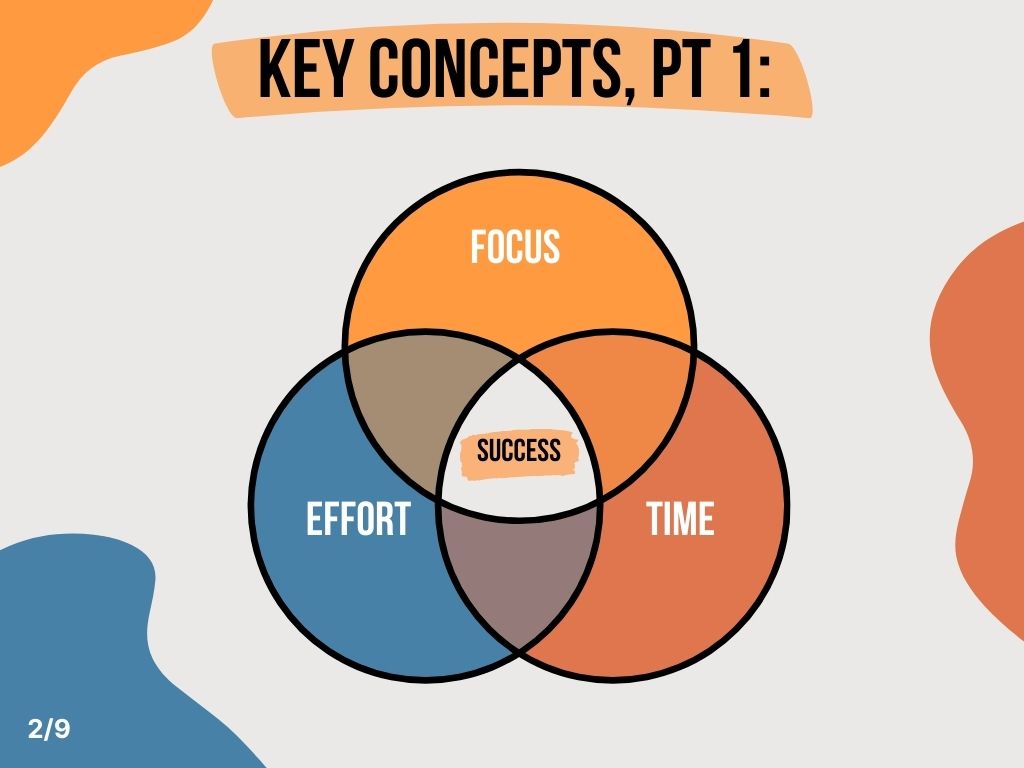
While onboarding a new client recently, we put the finishing touches on his success framework, which helps define what actions need to be taken in order for him to meet his goal.
It’s the bridge that helps him get from where he is to where he wants to be.
I wanted to share the general framework here so that others can use it.
You can check out the full slide deck on my social media (above) for the highlights, but I wanted to dive a bit deeper here.
The framework is broken down into three distinct parts:
Number 1 is an awareness of the key concepts and their definitions:
- Focus: where you want to go? Why?
- Effort: how hard do you need to work?
- Time: how long will it take?
Number 2 is what happens when two of the circles overlap, but leave out the third. These intersections have their own name and characteristics:
- Low Harvest = Focus + Energy, but no time. This happens when you have someone with extreme clarity on their goals working really hard…for a short amount of time.
- Folks at this intersection often find themselves with feelings of worry, distress, and compare their outcomes to others.
- No Harvest = Focus + Time, but no effort. These are the dreamers. They have a crystal clear vision of what they want and are patient for it to arrive. Yet they never do any actual work.
- People at this intersection are typically caught in the tension of “I’ll get started tomorrow”, leaving them filled with frustration in themselves as they grapple with a failure to do anything.
- Wrong Harvest = Time + Effort, but no focus. These are the ones who plant pumpkin seeds, till the soil, and water perfectly. Then they’re shocked when an apple tree grows. They spent a lot of time working really hard only to be confused by their outcome. This leaves them exhausted with nothing to show for all their efforts.
Number 3 is where the rubber meets the road and helps you figure out how to avoid the intersections described above. In short – it’s solution time.
- Want to get really clear on your focus? Then answer these questions, honestly:
- What harvest do you want to reap? Want to grow apple trees – then say that! Want to go on monthly date nights with your wife – then say that! Define it with as much detail as possible. In the fitness world, the worst thing someone can say is ‘I want to lose weight.’
- What distractions and obstacles have I encountered previously? This brings in your past experience as well as forcing you into thinking through how things might rob your focus. Do you frequently grab your phone to make a necessary social media post for your business and then find yourself in a puddle of drool two hours later after doom scrolling? Then list that.
- Where am I starting from? This keeps you honest about the gap between where you are and where you want to go. It also helps inform and influence the steps within the plan you (or your coach) design.
- Does this align with my values? I wrote in depth about this here, but the cliffs notes are this: we start with values because they offer a strong anchor that you can tie actions around to eventually create habits that turn into sustainable behaviors. Values deepen the buy-in to the work that needs doing, especially when things get tough or mundane.
- Want to get really clear on the effort required to reach your goal? Then answer these questions:
- What specific actions do I need to take? In the gym, this could be exercise selections, set, reps, rest, load, etc. At home, this could be your Saturday routine beginning at 8am: mow the lawn, clean the pool, wash the cars. You get the picture – the more detail, the better.
- What resources do I have available to sow? This can be time, money, your network, etc.
- Do I know anyone who has achieved this that I can ask about the work required?
- Is this adding to, or replacing, my current workload? Plainly put, this helps you understand if you will be working more hours or the same hours, but just differently.
- Want to get really clear on the time required to reach your goal? Then answer these questions:
- How soon do I need (or want) to reap what has been sown?
- Is this timeframe reasonable based on past experiences? How about after talking with others that have achieved similarly?
- What markers of progress would I like to see? This is helpful to have in place ahead of time, so that when you don’t see the metaphorical scale moving, you can have a different measuring stick that you are making acceptable headway.
- Does this align with my priorities? As outlined in the blog I linked about, priorities are a measurement of where we spend our time.
Next time you’re working towards something and find yourself caught with either the wrong harvest, low harvest, or no harvest, focus on the one key concept that is missing and answer the questions related to it.
Feel free to do so with yourself, your family, your work, or clients of your own. Let me know if you find it helpful…and please share it!
-
Margin

When I first opened my gym, I remember that as we grew, and demand for session times went up, I was enthusiastic about shoe-horning as many things back to back as I possibly could.
Ditto for when I started taking clients at Two-Brain. I set up my calendar with wide-open, reckless abandon and couldn’t wait for days that were packed with client after client.
I did this with the family too – I’d have my days set up to robotically go from one task to the next.
At a certain point, I started to feel that I was missing something.
In the gym, I missed being able to linger with folks before and after their session, just to catch up and exchange a few terrible dad jokes.
The trouble I quickly ran into taking clients over zoom, back to back, for seven hours in a row? BATHROOM BREAKS!
And at home, because I had become so tightly bound to a schedule, I missed the little in-between moments. Like when the kids would run out the front door as I was pulling away only for me to wave, instead of stopping and giving the courtesy rev that they so desperately wanted.
In short, I was missing margin.
So one day, I decided to change.
I purposely built in time between every session at the gym to allow me to deepen relationships.
Ditto for my calendar availability working with remote clients.
Oddly enough, when I accounted for margin at work, it naturally led to better time with the family.
I am certainly not optimized for mass efficiency and productivity, but I strive to be optimized for margin.
And I’m good with that.
So if you’re longing for those in-between moments, take a look at your calendar and see where you can pencil in more margin.
-
Subscribe
Subscribed
Already have a WordPress.com account? Log in now.
 For Glory